
Railway and Social Benefit?
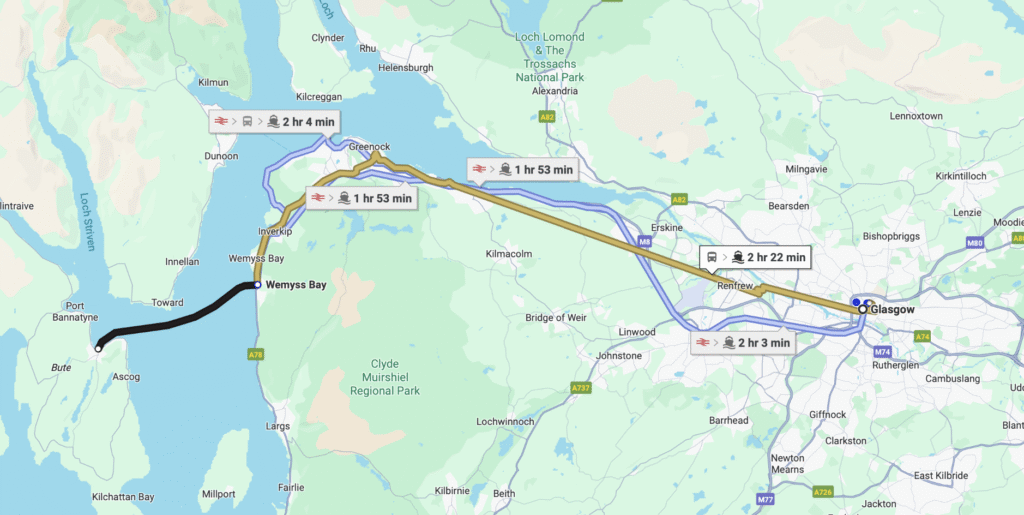
Recently I went to Scotland and visited the Isle of Bute. We took a short ferry trip from Wemyss Bay, which had a small railway station. I was very surprised that for a small town, it had quite a big terminal station. One can take a train from Glasgow, step off the platform at Wemyss Bay railway station, and walk a few metres before boarding the ferry to the Isle of Bute. Presumably this shows how the rail benefits the commuters who work in Glasgow and live along the way to Wemyss Bay, as well as tourists who might travel the route. Isn’t that wonderful how the rail benefits so many people? Or is it?
So I went to the Isle of Bute and visited the Mount Stuart House. The term ‘house’ is a bit of an understatement. It is humongous. And the house has marble stone almost everywhere in the house. I didn’t think much about it until I saw a comment in the guest’s book, wondering how the marble was brought to the house. I later went to the shore near the House and walked around the compound, so I observed that the island unlikely would have the natural resources to build the house. As I am not a builder/architect/civil engineer, so take that with a grain of salt.
Anyways when I went back home, it occurred to me that the materials were most likely brought from elsewhere, either from Glasgow, or even from all over the world. The former might have used the rail to transport the material to the port in Wemyss Bay, before being ferried to the island, while the latter can mean that ships from overseas directly stopped at the port. Which one it is, I don’t know and haven’t done the due diligence. My conjecture is that most of the construction materials came through rail transport, and the Wemyss Bay train station was built partly to serve this.
I was also reminded that at Wales for example, most of the railway or rail routes were used to transport coal or minerals, which were later mainly used as passenger route. I think there are still goods being transported but when one argues about the benefit of rail, the main point would normally be about how it has a low carbon impact. Of course it does, but many people, me included, do not include or consider how the railway had already sunk a great deal of carbon and money on its capital expenditure centuries ago, that we say it is a green and environmentally mode of transport. True, the infra is already there and it would be a waste to not use it. Also true, that even if we built a new rail line and a new motorway side by side, rail would still be ‘more’ environmentally friendly (I think I’ve read that somewhere but don’t quote me on that). However I just want to say that we sometimes forget the bigger/longer timeline and keep harping on the short term views.
So, does the railway have social benefits? Yes. Was it intentionally built so? I don’t think so. Doesn’t hurt for us to pivot the use though.
Thank you for reading.